
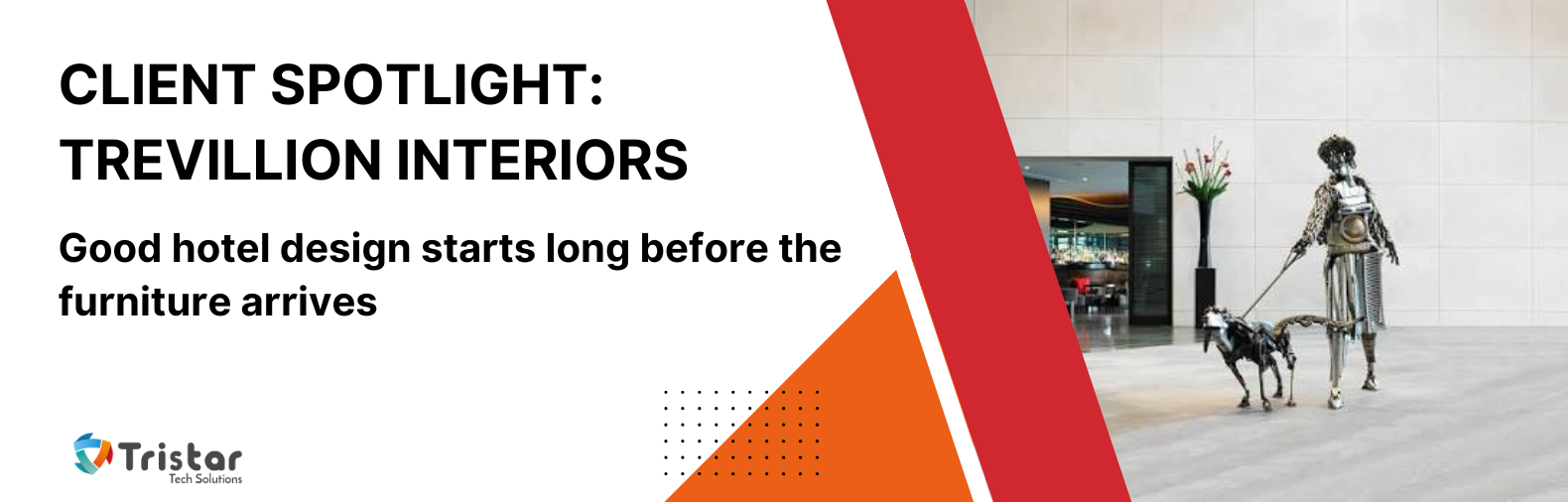
Walk into a well-designed hotel and you probably notice the atmosphere.
The lighting feels right; the furniture is comfortable, and the restaurant flows naturally. Everything seems effortless.
What you probably don’t notice is how many careful decisions made that experience possible.
How many people can be served breakfast at once without creating queues? Can staff move efficiently through a busy restaurant without constantly crossing paths? Will guests naturally find reception without needing signs? Will those floor finishes still be safe after thousands of guests have walked across them? Will today’s design still make commercial sense five years from now?
Those are the kinds of questions that have shaped Trevillion Interiors for more than fifty years.
Founded in 1972 by Bernard Trevillion, the business began at a time when smaller hotels were starting to evolve beyond simple roadside accommodation. As hotels increasingly became destinations for business meetings and corporate guests, owners needed something more than decoration; they needed environments that helped their businesses succeed.
And that principle has guided the company ever since.
Design is Only Successful When the Business Succeeds
One of the first things Director and owner, Frances Blackham, was keen to point out during our conversation was that people often misunderstand what interior designers actually do.
Having spent 35 years with Trevillion Interiors (including 25 years as Design Director) Frances took over the business last year, following two generations of Trevillion leadership: founder Bernard Trevillion and later his son, Mike. Having worked alongside both throughout her career, she brings a deep understanding of the company’s history, its approach to design, and the principles that have shaped it for decades.
“There is a difference between interior decoration and interior design,” she explained. “We do choose finishes and furnishings, but we also design restaurants, hotel bedrooms and public spaces that have to function operationally.”
That means making hundreds of decisions most guests will never realise someone had to make.
Where should waiting staff collect food so they are not walking unnecessary distances all day? Can housekeeping move efficiently between rooms? Will a reception desk cope comfortably with a coach arriving all at once? Will the chosen furniture still look good after years of constant commercial use?
Creativity is only one part of the job
Because every design decision has consequences.
After all, unlike designing a private home, hospitality projects must generate revenue. A restaurant layout that slows service, a lobby that creates bottlenecks at check-in, or finishes that need replacing far sooner than expected all affect the business long after the refurbishment is complete.
“We cannot spend money on things that have no commercial value. The design has to be commercially viable as well as attractive.”
Listening to Frances, it became clear that Trevillion is not simply designing attractive interiors. They are taking responsibility for how a hospitality business performs once the doors open.
That way of thinking has helped Trevillion earn a reputation within the hospitality industry as what Frances describes as “a safe pair of hands.”
And it has also shaped the company’s mantra: On time. On budget.
Behind those four words sits decades of experience in understanding where design, operations and commercial reality meet.
Technology Changes. Responsibility Doesn’t
Like many industries, interior design has transformed dramatically over the past few decades. Frances spoke about starting her career at drawing boards using set squares and Rotring pens. Presentation boards were assembled by hand, with fabric samples carefully mounted using double-sided tape.
Today, drawings are produced in AutoCAD, presentations are delivered digitally and visualisations can be created in minutes.
Artificial intelligence is simply the latest tool to become part of that evolution.
“It can generate ideas and produce images, but it cannot physically produce the outcome.”
That distinction says a great deal about how Trevillion approaches its work.
Technology can speed up design, improve communication and help explore ideas more quickly. But when a hotel opens, the responsibility for whether guests move comfortably through the building, whether staff can work efficiently, and whether the investment delivers lasting commercial value still belongs to the people behind the design.
The tools may change, but the responsibility never does.
Looking Beyond Hospitality
Although hospitality remains Trevillion’s specialist area, Frances believes the principles developed over decades could solve problems elsewhere; one such area is later-life living, where care environments have not kept pace with people’s expectations.
Today’s generation has grown used to well-designed homes, thoughtful interiors and comfortable environments regardless of budget. Yet many care settings still feel institutional rather than welcoming. Hospitality has spent decades learning how thoughtful design influences comfort, wellbeing and experience. Frances believes those same lessons could help create care environments where people feel genuinely at home while remaining practical for the people who work there every day.
It is another example of the same idea that has guided the business since 1972: applying design to solve real human problems.
Why Businesses Like Trevillion Matter
It is easy to think of interior design as something primarily aesthetic.
Our conversation with Frances suggested something quite different. The design businesses that create the greatest value are not simply choosing colours, finishes and furniture. They are making hundreds of decisions that help their clients operate more effectively, deliver a better guest experience and generate stronger commercial outcomes long after the project is complete.
That way of thinking resonated with us because it reflects how we approach IT at Tristar. Technology is not the objective. The objective is helping our clients run better businesses. Every recommendation, whether it’s infrastructure, security or support, is made in the context of reliability, productivity and long-term commercial value.
The disciplines may be different, but the principle is the same. Success isn’t measured by how impressive the design looks or how sophisticated the technology appears. It’s measured by whether the business performs better because of the decisions made behind the scenes.
About Trevillion Interiors
Established in 1972, Trevillion Interiors is an independent interior architecture and design practice specialising in hospitality environments. Based in Hertford, the team provides design, project management, procurement and feasibility services for both new-build and refurbishment projects, working with hotels, restaurants and leisure venues across the UK and internationally. Their approach combines creative design with technical expertise to deliver commercially successful spaces that perform as well as they look.
Are you ready to receive IT support that ensures your business runs reliably?
With our Free Partnership Review Call, you’ll get clarity about whether Tristar Tech Solutions is the right fit for your needs.
Call: 01707 378455
Email: hello@tristartechsolutions.co.uk
Frequently Asked Questions
What does Trevillion Interiors specialise in? Trevillion specialises in hospitality interior design, creating interior architecture and design solutions for hotels, restaurants, bars and leisure venues. The practice supports projects from initial concept through to procurement and project delivery.
How long has Trevillion been in business? The business was established in 1972 and has spent more than five decades designing hospitality environments across the UK and internationally.
What makes hospitality interior design different from residential design? Hospitality design has to balance guest experience with commercial performance. Every decision needs to consider operational efficiency, safety, durability, maintenance and return on investment; not simply aesthetics.
Does Trevillion only work with hotels? While hospitality remains its core expertise, Trevillion also designs restaurants, bars and other leisure environments, and is exploring opportunities to apply its hospitality knowledge to sectors such as later-life living.
How does Trevillion approach new technology such as AI? The team sees AI as a valuable design tool that can help generate ideas and improve efficiency, while recognising that successful projects still rely on human creativity, technical knowledge and professional judgement.